Your agent is great until it hits a messy inbox: customers don’t write like your test prompts, and the work rarely belongs to one tool.
The failure mode is predictable: you add a “triage channel” (often a private Slack channel) to sort it out, and you accidentally create a second inbox that’s harder to measure and easier to forget. Slack even documents triage channels as a way to organise incoming work, which is exactly why teams reach for them when volume rises. (slack.com)
The anti-pattern: triage channels as a second queue
A triage channel is a good pressure valve when the team is small and everything is tribal knowledge. But at 20–500 people, it tends to collapse into one of these shapes:
- Shadow decision-making: the “real” discussion happens privately, while the customer-facing thread gets a delayed, sanitised answer.
- Lost ownership: the request is “seen” in Slack, but not owned in the system of record.
- Broken audit trail: you cannot reconstruct why a refund was approved, why an outage update was phrased a certain way, or which artefacts were checked.
- Queue multiplication: inbox + triage channel + ticket backlog + engineering board, each with different states.
If you’re building agentic automation, a triage channel is also the easiest place to hide an agent’s weaknesses. It can “help”, but it cannot finish.
The pattern worth building is the opposite: keep work in the original thread, give the agent constrained tools, and make escalation and closure explicit.
A concrete pattern: in-thread, tool-using resolution
The design goal is simple:
- The customer’s conversation remains the canonical artefact.
- The agent can do real work (query systems, create changes, initiate refunds) but only within narrowly-scoped permissions.
- Internal collaboration happens inside the same case, not in a detached channel.
In practice, you want three threads, all linked:
- Customer-facing thread (email / Intercom conversation / Zendesk ticket comments / shared Slack Connect channel)
- Internal notes thread (visible to staff, not the requester)
- Tool run trace (a machine-readable record of decisions and tool calls)
Most support platforms already have a notion of “keep collaboration separate but attached”. For example, Zendesk has internal notes and “side conversations” inside a ticket (separate discussion space with specific participants). (support.zendesk.com) Intercom similarly supports internal notes and tickets as a collaboration unit around the customer conversation. (intercom.com)
Your agent should operate in that same unit.
The workflow you’re aiming for
At a high level:
- New message arrives (email, chat, Slack Connect, webhook).
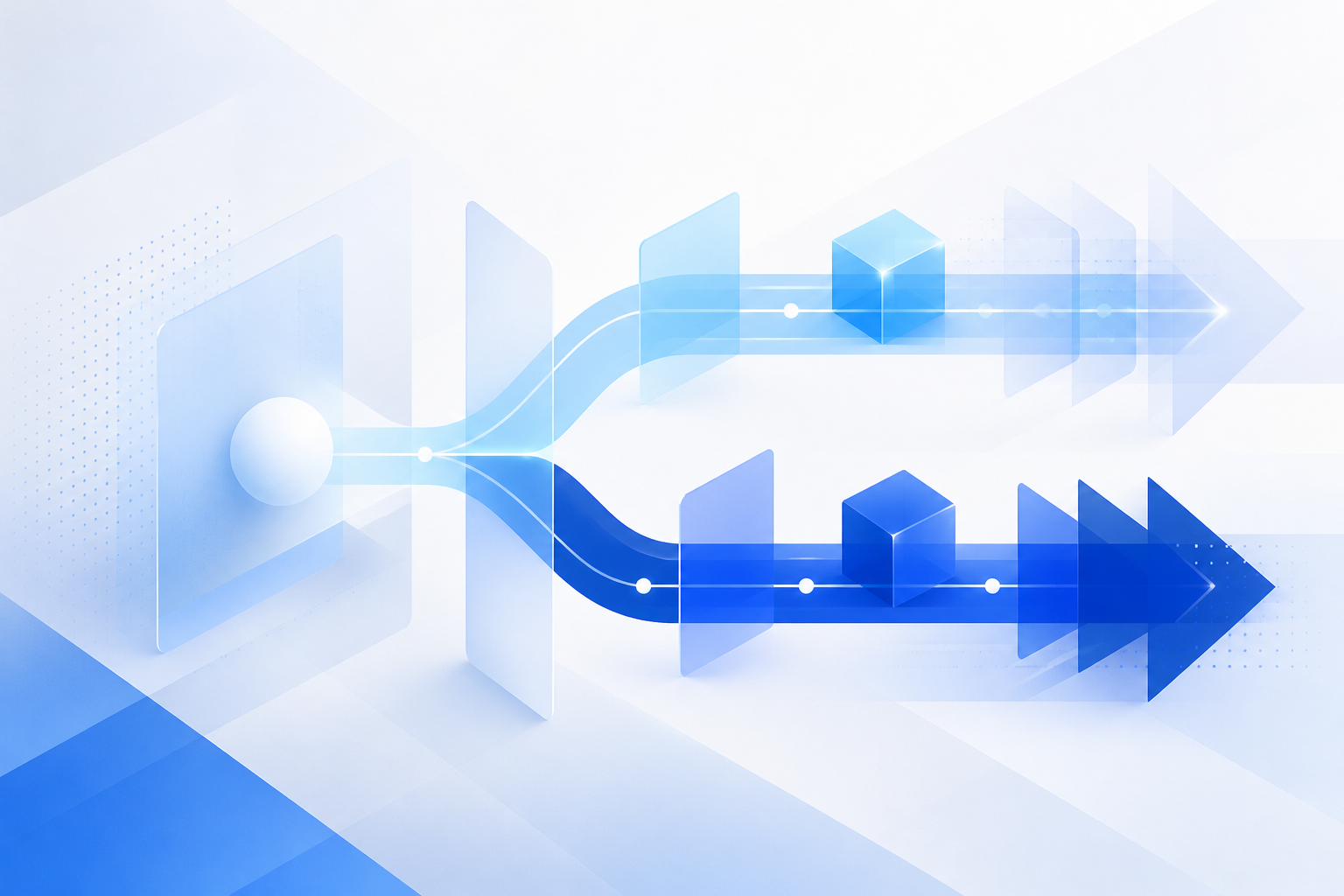
- A router assigns it to an agent policy (or straight to a human) based on risk and tool access.
- The agent executes a plan with tools, writing progress into internal notes.
- If needed, the agent performs a controlled handoff to a human with a complete packet.
- The agent (or human) replies in the customer thread.
- The system records the outcome and runs thread-level evaluation after closure.
That “router + permissions + closure + eval” loop is the actual product. Model quality matters, but it is rarely the bottleneck.
Routing is the hard part (and should be mostly deterministic)
Teams often start with “let the model classify the ticket”. That works until it doesn’t, and when it doesn’t, it misroutes the one ticket you really wanted to keep safe.
A more reliable pattern:
- Use rules for risk, and LLMs for extraction and summarisation.
- Route based on what the agent will be allowed to do, not just what the user asked.
A pragmatic routing stack looks like:
- Hard rules (fast, boring, correct): sender domain allowlists, authentication state, plan tier, keywords that imply money movement (“refund”, “chargeback”), security-sensitive terms (“breach”, “2FA”), legal (“DPA”), and “angry but important” signals (VIP account, production down).
- LLM extraction (helpful, not trusted): product area, likely intent, entities (invoice ID, workspace ID), and a suggested next action.
- Decision: choose one of a small number of agent policies.
If you do only one thing to avoid building a new queue, do this: make “cannot safely proceed” a first-class route, not an exception.
Tool permissions: the difference between a demo and production
An agent that can “read Zendesk and write Jira” is not enough. The permissions need to be granular and explainable.
Concrete approaches that work:
- Scoped OAuth where possible. For example, Google’s Gmail API distinguishes full mailbox access from narrower scopes;
gmail.modifyexplicitly covers reading, composing, and sending email. (developers.google.com) (Even then, be careful: the scope is still broad in human terms.) - Service accounts per capability: one credential for “read billing”, another for “issue refund up to £X”, another for “revoke tokens”, each with separate approval.
- Two-phase commits for risky actions: the agent can draft a refund, but a human (or a policy engine) approves execution.
The failure mode to name explicitly: if you give a single agent a single “support super-token”, you will eventually be forced to turn it off after an incident, and you’ll be back to manual triage—except now you have automation-shaped holes in your process.
Handoffs without a new queue
Handoffs are where triage channels thrive: “can someone from billing take a look?” The trick is to keep the handoff inside the case.
Good handoffs have:
- A clear owner (who is accountable for the next step)
- A bounded ask (what decision or action is required)
- The relevant artefacts already attached (logs, customer IDs, policy references)
Zendesk side conversations are an example of the right shape: a conversation inside a ticket with a specific subset of participants, without cluttering the main requester-facing thread. (support.zendesk.com)
If you don’t have that feature in your stack, implement the concept yourself: internal notes + mentions + explicit assignee changes.
The “handoff packet” (what the agent must produce)
This is a real list because it should be a contract:
- A one-paragraph summary of the issue in neutral language
- The customer’s goal (what “done” means to them)
- The system state observed (what the agent checked, with timestamps)
- The actions already taken (tool calls, config changes, credits issued)
- The proposed next action and why it’s blocked
- The risk flags (security, data deletion, finance, compliance)
- A link or ID for the run trace
If your agent cannot produce this reliably, do not let it escalate automatically; it will just manufacture a nicer-looking triage queue.
Closing the loop: don’t stop at “reply sent”
Most support automation fails at “we replied quickly” rather than “we resolved correctly”. Closure requires two additional pieces:
- State transitions in the system of record (ticket solved, incident resolved, bug filed, refund completed)
- Post-run evaluation that tells you whether the overall thread achieved its goal
This is where 2026-era practice has moved: teams increasingly treat agent behaviour as something you can inspect and score at the level of a run, a trace, and a full conversation thread.
OpenAI’s Agents SDK, for example, explicitly supports tracing that records tool calls, handoffs, and other events in an agent run, and lets you group runs under a shared ID (often a thread ID) so you can reason about an end-to-end workflow rather than single calls. (openai.github.io)
LangSmith similarly talks in terms of runs/traces/threads, and supports thread-level evaluators for multi-turn interactions rather than scoring isolated turns. (langchain-5e9cc07a.mintlify.app)
The practical insight: once you can evaluate at the thread level, you can stop optimising for clever single answers and start optimising for resolution.
The minimal architecture that actually works
If you’re deciding whether to build, this is the smallest set of components that tends to survive contact with production:
- Ingress adapters: email, Intercom/Zendesk webhooks, Slack Connect events.
- Case store: ticketing system is the source of truth for state; your service stores agent metadata and trace IDs.
- Router: rules-first risk gating + LLM extraction.
- Tool layer: typed, audited actions (read-only by default; write actions behind explicit policies).
- Agent runner: executes plans, writes internal notes, requests approval, performs handoffs.
- Observability: traces linked to case/thread IDs.
- Evaluation: thread-level scoring on closure (plus spot checks on high-risk classes).
If you’re missing observability and eval, you will not know whether the system is improving or silently regressing.
Trade-offs and when not to do this
This approach is not always the right answer.
Do not build end-to-end, tool-using support agents if:
- You cannot define “done” for your top issue types (you will end up evaluating vibes).
- Your internal systems are not safe to automate against (no audit logs, no RBAC, no staging).
- Your workflow is dominated by high-stakes judgement (medical, legal, large financial approvals) where automation mainly creates liability.
- Your organisation cannot commit to owning the routing and permission model (it will rot).
Also note the operational trade-off: you are moving work from “humans triage in a channel” to “engineers maintain workflow software”. That is a good trade at 20–500 people when support volume is real, but it is still a trade.
The goal is not fewer messages. The goal is fewer unresolved threads.
Where codeversols fits (briefly, honestly)
If you choose to build this, most of the risk sits in integration and workflow correctness: tool boundaries, approval flows, and making sure escalations don’t create a shadow queue. That’s the kind of work we do at codeversols across web, cloud, and AI engineering—shipping systems that have to behave deterministically around the LLM, not just produce plausible text.
Close
Replacing a triage channel is less about a better model and more about better plumbing: deterministic routing, least-privilege tools, explicit handoffs, and thread-level closure.
If you build those pieces, the agent stops being a helper in a private channel and becomes something more valuable: a system that can take a messy inbox and reliably turn it into resolved work, in the thread where it started.